Weekend Surf Forecast: August 1-2, 2026
Every number below comes out of our own nearshore SWAN model — a 50 m grid that resolves what a swell actually does once it feels the sandbar or the reef, rather than what a buoy 20 miles offshore is reading. Here is the honest read for August 1–2: one region is worth setting an alarm for, and most of the rest are not.
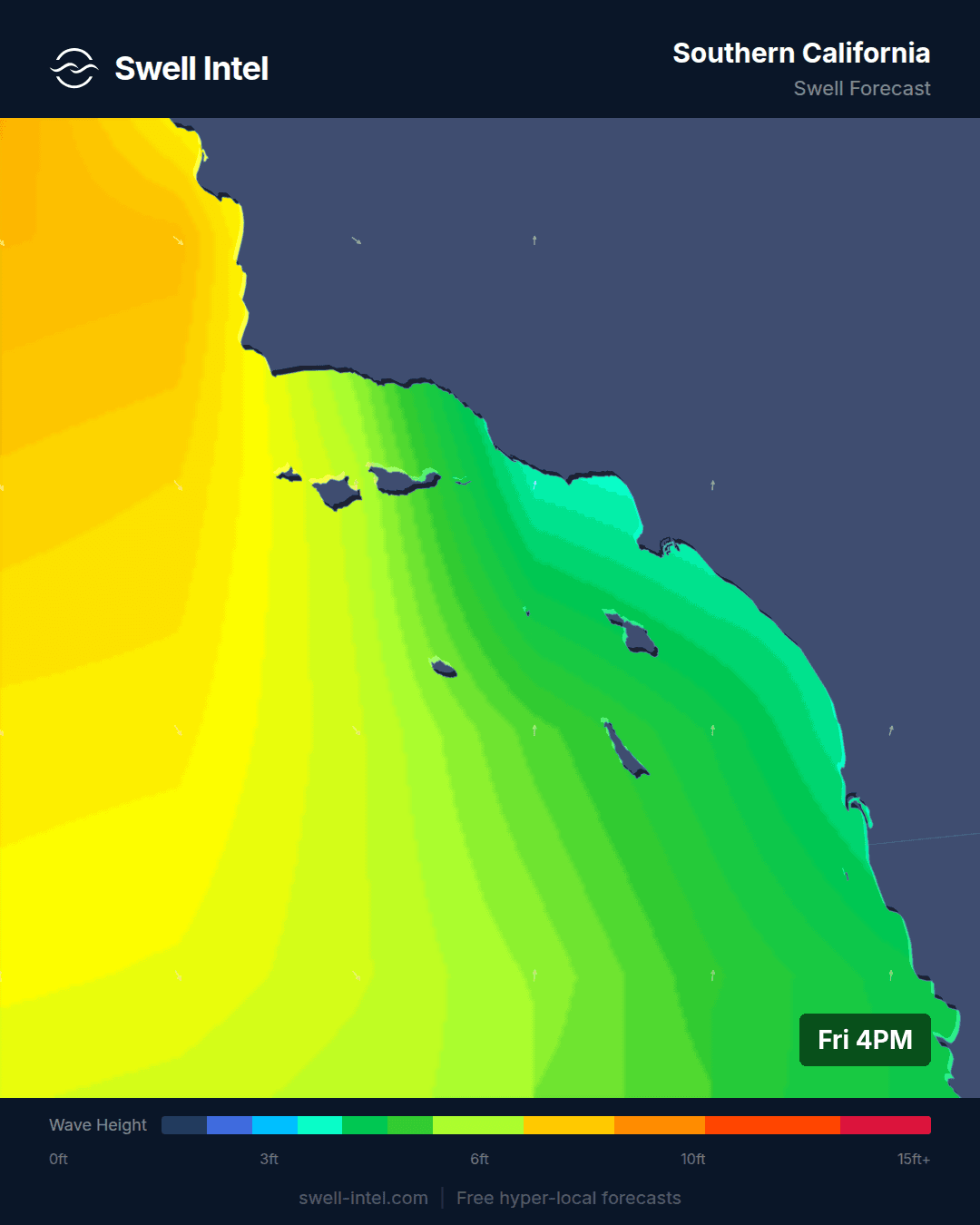
Southern California has a genuine 13–14 second south groundswell in the water, and it is the only place on this list where the model likes the conditions. The Pacific Northwest and the Bay Area have size but no period behind it, so both are morning-only and wind-dependent. The entire Atlantic seaboard — Long Island to Florida, plus Puerto Rico — is deep in the August lull: knee-to-waist short-period windswell with nothing spinning offshore to change it. The setup is simple enough to state in one line: the Southern Hemisphere is in peak winter and firing swell north, the North Pacific High is parked and making local windswell, and the Atlantic hurricane season has not woken up yet.
Jump to your coast
- Southern California — the standout
- Northern California
- Pacific Northwest
- New York / New Jersey
- New England
- Outer Banks
- Florida East Coast
- Puerto Rico
Southern California

Surf: 2-3ft • Best day: Saturday AM • Conditions: Good
This is the one. Our model has 13.5 seconds from 186° at Trestles, 13.6 seconds from 186° at Malibu and 11.9 seconds from 178° at Huntington Pier — a Southern Hemisphere groundswell arriving from almost due south after a multi-thousand-mile run up from the Southern Ocean. August is the heart of that season, and a 13-second period is the difference between energy that reaches the sandbar with something behind it and the gutless windswell most of this forecast is made of.
Trestles is the standout at up to 5ft on the better Saturday sets — head-high — with Huntington Pier and Malibu First Point both peaking around 4ft. Take the region-wide 2-3ft as the honest read for most of the session and the spot peaks as what the best sets do. The spread across the region is all about angle: Trestles' cobblestone points sit wide open to due-south energy and convert it better than anywhere else in Southern California, and 186° is close to a perfect wrap into First Point at Malibu. Cardiff Reef takes a haircut at 3ft and Fair, and El Porto is the plain call to skip — a west-facing South Bay beach sits at a bad angle to straight south swell, and the model has it at 2ft and Poor-Fair while the south-facing points are twice that.
Go early. Our hour-by-hour ratings average 2.4 in the morning against 1.5 at midday and 1.5 in the afternoon — the sea breeze running on its usual summer schedule, glassy at dawn and textured by late morning. Saturday edges Sunday. Confidence is high on size, since five separate spots are reading the same 13-second band, and moderate on exactly when the breeze fills in.
Northern California

Surf: 1-2ft • Best day: Sunday AM • Conditions: Fair
Same swell, far less of it. Ocean Beach reads 13.1 seconds from 200° — that is the identical South Pacific groundswell lighting up Trestles, picked up independently 400 miles north, which is a useful confirmation that the source is real. The problem is geometry: this coast faces west to northwest, so a south-southwest swell arrives at a sharp angle and most of the energy slides past.
The result is a hard split. Ocean Beach is the only NorCal spot with real size at up to 4ft and Fair. Linda Mar in Pacifica sits at 2ft and Poor, its dominant band a 7.5-second windswell from 293° with no push behind it — the south energy largely does not get into that cove. If you are choosing, it is Ocean Beach or stay home.
Sunday morning is the window, with ratings falling from 0.8 in the AM to -0.2 by the afternoon. The standard caveat applies: 4ft at Ocean Beach on a 13-second swell is not a mellow 4ft — the bars are shifty and the rips run hard. Confidence is moderate here, because at OB the sandbanks decide as much as the swell does.
Pacific Northwest

Surf: 2-3ft • Best day: Sunday AM • Conditions: Fair
Size without period. Everything up here is running 8.2 to 8.8 seconds from 262° to 282° — west to west-northwest, which is not groundswell but locally generated windswell off the North Pacific High's persistent northwest gradient. It is honest surf, just not powerful surf: short-period energy stands up quickly and folds without much wall.
Indian Beach holds the most at up to 5ft, with Cape Kiwanda and La Push both at 4ft — La Push on the most westerly band at 8.2 seconds from 262° — and Seaside Cove the weakest of the group at 3ft and Poor-Fair. Nothing rates better than Fair anywhere in the region. Cape Kiwanda is the sensible pick if the northwest wind gets on it early, since the headland buys some shelter the open beaches do not have.
Sunday morning, and be specific about it: the AM rating averages 1.5 against 0.3 in the afternoon, the widest intraday spread of any region this weekend. That gap is the tell that wind, not swell, is the deciding variable here. Dawn patrol or don't bother.
New York / New Jersey

Surf: 1-2ft • Best day: Saturday AM • Conditions: Poor-Fair
It is not going to be great. Rockaway, Manasquan and Pacific Blvd all top out at 2ft on a 7.8-to-7.9-second southeast windswell — 147°, 134° and 149° respectively. At that period there is no groundswell push; it is short, weak and quick to close out. Manasquan is the marginal pick at Poor-Fair, with 134° coming in at the more useful angle for the New Jersey bars, while Rockaway and Pacific Blvd both sit at Poor.
If you go, go at first light. Our ratings run 0.1 in the morning, -0.3 at midday and -0.7 by the afternoon — the southeast sea breeze piling onto a swell that had nothing to spare. This is a longboard weekend on the sandbars, and an honest one to skip if the drive is long. The Atlantic simply has nothing spinning yet.
New England

Surf: 0-1ft • Best day: Saturday AM • Conditions: Poor-Fair
The quietest region on the board, and we are not going to dress it up: 0-1ft is the typical read, with 2ft the absolute peak anywhere. The Rhode Island south-facers have the better band — Narragansett Beach at 8.4 seconds from 174° and Misquamicut at 8.4 seconds from 165° — and both are still only Poor-Fair. Hampton and Nantasket are working with 6.3 and 5.9 seconds from 83° and 63°; at those periods it is wind chop reaching the beach, not swell.
If you are already there, Narragansett or Misquamicut on Saturday morning is the best of a thin set of options — knee-to-waist on the sets, small and mushy. Otherwise this is a log day or a skip. New England earns its reputation in the fall on hurricane groundswell and in the winter on nor'easters, and neither is on the table in the first weekend of August.
Outer Banks

Surf: 1-2ft • Best day: Saturday AM • Conditions: Poor-Fair
Hatteras is normally the best swell magnet on the East Coast, sitting far enough out into the Atlantic to catch what the mainland beaches miss. This weekend there is simply nothing to catch. Cape Hatteras reads up to 2ft on 7.5 seconds from 157° and rates Poor-Fair, which is the best of it. Folly Beach Pier shows a bigger number at 3ft but rates Very Poor — 6.7 seconds from 142° is wind-driven chop that jacks up and shuts down, and the height there flatters it.
Saturday morning is the window. The bigger point is seasonal: early August is pre-peak in the Atlantic, and the tropical swell windows that make Hatteras worth planning around generally do not open until the middle of the month. This is a waiting weekend, and we would rather say so than talk you into a drive.
Florida East Coast

Surf: 1-2ft • Best day: Sunday AM • Conditions: Poor-Fair
Ankle-to-waist, with one spot worth the effort. Sebastian Inlet is the pick at up to 2ft on 8.4 seconds from 80° and Poor-Fair — the inlet's bars focus what little energy is arriving, which is exactly why it is the quality option in Florida whenever the swell is marginal. Cocoa Beach is the same 2ft on 8.2 seconds from 94° but only Poor. Jacksonville Beach is running a 4.0-second band from 149°, and that is not swell at all — that is local chop.
Sunday is narrowly better than Saturday, and mornings win, but be clear on why: our ratings are essentially flat across the whole day at 0.0, 0.0 and -0.1. Nothing about the swell peaks in the morning — you go early because the wind is calm, not because the surf improves.
Puerto Rico

Surf: 0-1ft • Best day: Sunday PM • Conditions: Poor
Flat, and exactly as it should be for the date. Maria's reads 1ft and Very Poor on 6.1 seconds from 61°, and Wilderness — which normally runs a couple of feet bigger than Rincon — manages 2ft and Poor on 6.3 seconds from 68°. Both are trade windswell wrapping around the island rather than anything from a storm. The northwest coast is dormant from June through September; that is the season, not a bad weekend.
Our model nominally puts Sunday afternoon slightly ahead of the mornings, but "least bad" at a Poor rating is not a session, and we are not going to pretend otherwise. Rincon and Aguadilla come alive when the North Atlantic starts sending north and northwest groundswell from October onward. Save the boards and the gas.
Track it live
These are model calls made on Friday for the weekend ahead — swell fills in and wind shifts, and the morning-versus-afternoon splits above are the part most likely to move. Track the live nearshore forecast for every spot named here, updated as the model runs, in Swell Intel.
📱 Get spot-by-spot forecasts, dawn patrol alerts, and buoy-trained ratings in the SwellIntel app.